Search the site...

Autism Spectrum Explained
  • Home
  • Introduction to Autism
    • Characteristics
    • Common Myths >
      • Negative Narrative >
        • Autism Controversies
  • How to Interact
    • Stigma & Discrimination
    • What to Avoid
  • Advice for Parents
    • Visual Supports
    • Autism Treatments
    • Explaining Autism to Kids
    • A Mother's Story
    • My Sibling Perspective
    • Autism Explained for Kids Site
  • All Kinds of Minds
    • Culture of Autism
    • Late Diagnosis
  • More
    • How to Assess Claims
    • What Causes Autism?
    • Additional Resources
    • Site Info & Feedback >
      • About the Website
      • ASE FAQ
      • Survey
      • Contact Us
      • Make a Submission
  • Our Blog
    • On Self-Advocacy
    • Trouble with Changes
    • Smoothing Transitions
    • Autism Speaks
    • Vaccines
    • Infantilization
    • Her Autism is Worsening
    • Stimming
  • Autism Tutoring
  • Home
  • Introduction to Autism
    • Characteristics
    • Common Myths >
      • Negative Narrative >
        • Autism Controversies
  • How to Interact
    • Stigma & Discrimination
    • What to Avoid
  • Advice for Parents
    • Visual Supports
    • Autism Treatments
    • Explaining Autism to Kids
    • A Mother's Story
    • My Sibling Perspective
    • Autism Explained for Kids Site
  • All Kinds of Minds
    • Culture of Autism
    • Late Diagnosis
  • More
    • How to Assess Claims
    • What Causes Autism?
    • Additional Resources
    • Site Info & Feedback >
      • About the Website
      • ASE FAQ
      • Survey
      • Contact Us
      • Make a Submission
  • Our Blog
    • On Self-Advocacy
    • Trouble with Changes
    • Smoothing Transitions
    • Autism Speaks
    • Vaccines
    • Infantilization
    • Her Autism is Worsening
    • Stimming
  • Autism Tutoring

Poem

4/6/2014

2 Comments

 
Originally posted 4/5/14

Autism Understanding/Acceptance Day 3:

Patricia posted this earlier and I thought it to be such an eye-opening poem that I wanted to share it because it shows the dual narrative of how we refer to neurotypical vs autistic behaviors in different lights. The double standard quickly becomes clear, and the artifical divide between our two communities still clearer.

The Language of Us and Them, By Mayer Shevin

We like things.
They fixate on objects.

We try to make friends.
They display attention-seeking behaviors.

We take a break.
They display off-task behavior.

We stand up for ourselves.
They are non-compliant.

We have hobbies.
They self-stim.

We choose our friends wisely.
They display poor peer socialization.

We persevere.
They perseverate.

We love people.
They have dependencies on people.

We go for walks.
They run away.

We insist.
They tantrum.

We change our minds.
They are disoriented and have short attention spans.

We are talented.
They have splinter skills.

We are human.
They are…….?
2 Comments

Light It Up Blue Part II

4/6/2014

0 Comments

 
Originally published 4/5/14

As if to prove my point about the importance of including additional material for education, yesterday I passed two signs that said "Light it up blue" with a tiny logo for Autism Speaks that you couldn't even see safely because the sign was so far away.

That's it. Light it up blue. It didn't say why, it didn't teach the reader anything about autism, all it did was say those four words. The signs also were mass-produced rather than being hand made, so my guess is they're all over the country.

Judging from where the signs were located, a lot of time and energy went into affixing them there. So obviously those who put them up cared a lot about autistic people to go through all that effort and thought they were helping them by doing so.

This is exactly what I mean when I say that when we're doing something to promote autism awareness/understanding/acceptance we should ask ourselves, how is what I'm doing impacting the autistic community? Because I'd say those signs would never have passed that test.

-Creigh
0 Comments

On Light It Up Blue for Autism

4/2/2014

0 Comments

 
Picture
Today is Autism Awareness Day (and Autism Acceptance Day). I'll be putting out a post about that shortly, but for now I wanted to write a post on the idea of "lighting it up blue for autism". Light it up blue deeply frustrates me. I remember when I was in college there was an Autism Speaks U club on campus. They told me they had succeeded in convincing the university to light it up blue for autism. My initial reaction was, great! 

Then I asked, are you going to have flyers to educate people about autism?
No.
Are you going to have people standing next to these blue lights tellling people why they're blue?
No.
So how is this at all helpful for autistic people?
...no response.

Even if on the off chance a bystander realized that it was blue because of autism awareness (and the mere recognition of that fact indicates that they're already aware of autism)....what does that blue light teach them about autism? Absolutely nothing. And that is just one of the many reasons why I'm not a supporter of light it up blue, the others being that even if facts about autism are given, they tend to be factoids like "1 in 68" that lead to "cocktail party awareness" as Diary of a Mom put it, and additionally I'm concerned the campaign feeds fear, not understanding.

So if you choose to light it up blue today, I'm going to ask you to PLEASE provide information along with that color. And make it meaningful information - if you're at a loss for what to say, feel free to go to the Characteristics page or the Myths page of the ASE website for some suggestions that would truly make the world a better place for autistic people if everyone understood. Out of the two, I'd say mythbusting is far more important since there are so many toxic ideas about autistic people out there. 

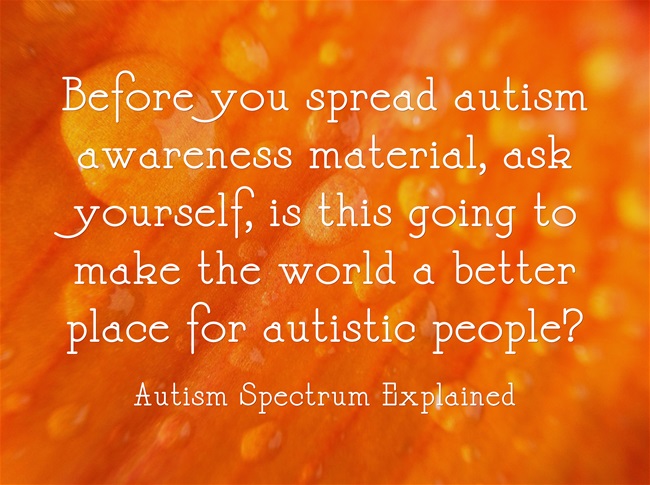
No matter what we choose to do, we should always ask ourselves, is this going to make the world a better place for autistic people? Because that's the ultimate goal, but that's not always what we're accomplishing.

-Creigh

Characteristics page:
http://www.autismspectrumexplained.com/characteristics.html
Myths page:
http://www.autismspectrumexplained.com/common-myths.html
0 Comments

Understanding: The Bridge Between Awareness & Acceptance

4/2/2014

0 Comments

 
I have been wanting to write this post for the longest time and today, World Autism Awareness Day along with World Autism Acceptance Day, seems like the most appropriate time to do so.

First, some background. There are two loose, informal sub-communities within the autism community. I already talked about them more within the website, but they include a "pro-cure" camp and a "pro-acceptance" camp. These camps divide the community and, almost like political parties, one's feelings towards either camp generally line up with positions on a variety of autism-related issues, from treatments, to research, to organization.

The reason I gave you this background is that this schism applies to Autism Awareness Day vs Autism Acceptance Day, too. The pro-cure supporters mostly line up with Autism Awareness Day proponents. And Autism Acceptance Day was created as a pro-acceptance alternative and generally intended to be a direct counterpoint to Autism Awareness Day.

To choose to support one cause, awareness or acceptance, is generally to choose to deny another. And so here I stand, stuck in the middle because I support both causes. I support autism awareness, not the cocktail party "1 in 68" kind, but true awareness of the existence of autistic individuals towards the goal of helping children get diagnosed. Granted, I believe the importance of this goal is waning in the United States, as we've done a superb job of making people aware of autism's existence here, but as someone who has traveled abroad, I strongly feel that autism awareness is a critical cause in other countries I've visited, like China.

Yet I support autism acceptance as well. Because I look at what my sister needs and wants and what the children I've cared for over the years would benefit from, and hands down the answer is acceptance. Acceptance, as they say in the community, is an action. It's seeing the autistic individual in front of you and still giving them all the accommodations and therapy that will help them - but at the same time, it's valuing them for who they are. And that is one of the most important gifts you can give any autistic person.

But more than either one of those, I support a third cause, that of autism understanding. Because understanding is the bridge to acceptance. After all, if you're merely aware of autism but think it's a symptom of a disease separate from your child, or that your child is "trapped in their autistic world" a terrible world from which they can emerge if only you find the right treatment, when told that you should accept your child as autistic you're more likely to scoff or even react with horror at the notion than to do so.

I guess what I'm saying is, there are three causes in the autism community: Awareness, Acceptance, and Understanding. Here in the United States, we've done a great job with awareness and we're moving on to acceptance, but before we can get there we need the bridge of understanding to guide us. Thankfully, I think that's a cause that anyone in the autism community would be proud to stand behind.

So this month, I'm going to devote myself to the cause of Autism Understanding, along with Autism Awareness and Autism Acceptance. Each day I'm going to share a new photo that promotes understanding of autistic individuals and seeks to combat stigma and false ideas about autism. Feel free to share mine or make your own.


Together, we can make the world a better place for autistic people.


-Creigh
0 Comments

On Autism and Divorce

4/1/2014

2 Comments

 
Picture
Originally published 3/20/14

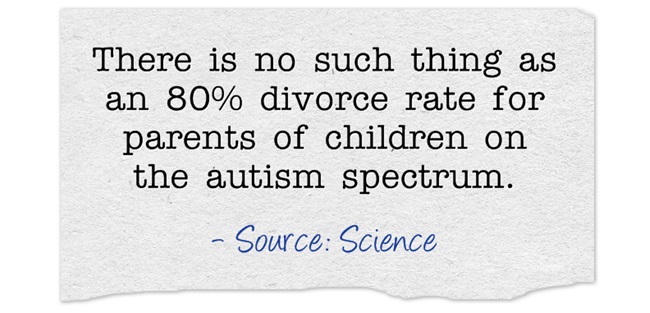
Parents of children on the spectrum DO NOT have an 80% divorce rate. I am fed up with this myth. Those of you who know us know my sister and I have divorced parents. When they divorced (as many do), Caley Googled autism and divorce, looking for resources to help autistic people like her. What she found every child's worst nightmare - "proof" in the form of the 80% 'statistic' that she was responsible. You can imagine how that felt, and you can also imagine that she's not the only autistic person to have gone through that painful experience, an experience which they shouldn't have to confront because this claim is patently false.

I have researched this claim silly and found three studies - two that pointed to no significant difference in rates of divorce between parents of neurotypical children vs autistic children and one which pointed to a very slight increase (23.5% vs. 13.8%). I've known many parents of children on the spectrum who heard this statistic and felt their marriage was doomed to failure. If you are one of these people, know that it is not. Researchers found that having an autistic child could be difficult for parents' marriages, but it was just as likely to bring them closer together. The moral of the story is, parents of children on the spectrum get divorced about as often as parents of neurotypical children do, certainly not at an 80% rate. So please, share this picture and refute this myth whenever you hear it for the sake of the parents and their children alike. This myth is toxic and needs to go away, and if we all work together we can help it do so. Thank you.

If you want more information, I'll let the studies speak for themselves:

Relationship Status Among Parents of Children with Autism Spectrum Disorders
Journal of Autism and Developmental Disorders, April 2012, Volume 42, Issue 4, pp 539-548
"A total of 77,911 parent interviews were completed on children aged 3–17 years, of which 913 reported an ASD diagnosis. After controlling for relevant covariates, results from multivariate analyses revealed no evidence to suggest that children with ASD are at an increased risk for living in a household not comprised of their two biological or adoptive parents compared to children without ASD in the United States."

A comparative study of the marital relationship between parents with children with autism and those with children without autism
Good Autism Practice (GAP), Volume 14, Number 1, May 2013 , pp. 28-33(6)
"In this paper, they report on a large-scale study which explored the nature of the marital relationship for 475 mothers of children with autism and 62 mothers of typically developing children. ... The authors do in fact find that there are generally more difficulties in the marital relationship of those parents with a child with autism, but that most of these parents stay married and also report that the experience has strengthened their relationships in some cases and they have experienced positive emotions as well as having difficult times."

The relative risk and timing of divorce in families of children with an autism spectrum disorder.
Hartley, Sigan L.; Barker, Erin T.; Seltzer, Marsha Mailick; Floyd, Frank; Greenberg, Jan; Orsmond, Gael; Bolt, Daniel
Journal of Family Psychology, Vol 24(4), Aug 2010, 449-457. doi: 10.1037/a0019847
"Parents of children with an ASD had a higher rate of divorce than the comparison group (23.5% vs. 13.8%)." [Again, note this is a SLIGHT difference and the number doesn't nearly reach 80%.]

-Creigh
2 Comments

Speak for Yourself

4/1/2014

0 Comments

 
Originally published 3/17/14

In the autism community, the pronoun "we" is used too much. This is a problem I've noticed and I'm uncomfortable with coming from both sides of the community. I already posted on the ASE Facebook page about my discomfort with "The Reason I Jump" in which the autistic author claimed to speak as "we autistics"...even though not all autistic people would agree on what he was saying. I had the same discomfort with the article discussed by Diary of a Mom, What Parents of Autistic Children Will Never Tell You, which used the "we parents" phrase. And these are only two tiny examples in a much wider problem.

I do not seek to devalue Naoki Higashida or Jo Worgan or any of the many, many writers and speakers who have spoken as "we ____" when I say this. Their words, their experiences, their right of expression, these are all valuable things. I learned from what Naoki and Jo wrote and I would never desire them or any one of the other authors who has employed "we" to stop writing, or to feel like they were under attack for their slip of a pronoun.

It's not their fault and I do not write this to shame or silence them. They were trying only to help, to express their very valid thoughts and feelings about what it's like to be a part of the autism community, and to help others in their situation who they assumed felt the same way. In many cases, they thought rightly, and their words have certainly resonated with many, though not all.

But we, and I do mean we, need to change this idea that one person can speak for everyone, this assumption that our experiences are alike. Because we are a very diverse community and while it is important that we speak for ourselves, it is equally important that we not put words in the mouths of others.

-Creigh
0 Comments

Believe

4/1/2014

0 Comments

 
Originally published 3/13/14

When I moved into my new dormitory a while back, there was a guy there I hadn't met before. We started talking about autism and I told him about all my advocacy and mentioned my sister was on the spectrum. Then he told me that he'd peer mentored a girl with autism during orientation. He went on and on about what a really cool girl she was and how she was so awesome. Suddenly I froze. "What's her name?" I asked. "Caley," he replied. And out of nowhere and much to his surprise, I hugged him, a complete stranger, on impulse. As I was hugging him, I whispered, "That's my sister."

What made this moment so beautiful wasn't that he thought Caley was cool, although that was also great. It was that it came during a deluge of negative talk, a time where well meaninged people, professionals and laypeople alike, kept insisting that Caley would never go to college, that she'd never succeed. Not for any reason other than the fact that she's autistic. And here he was, telling me that he'd met her at college and thought she was awesome and doing really well there. I cannot express to you my emotions in that moment - but I think you can imagine.

What I'm saying in this post, is just believe. Believe in the competence of anyone you know on the spectrum, even when others don't. Because they're far more competent than society would have you think. -Creigh
0 Comments

ASE's One Year Anniversary!

4/1/2014

0 Comments

 
Originally published 3/9/14

One year ago today, Autism Spectrum Explained was published. At that point, there were just a few articles and the only readers were a handful of family and friends. Today there are seventeen articles (and eight more almost ready for publishing) and visitors from all over the world. I think what I'm trying to say is, the website has grown a lot.

Today I'm aware of how much I've grown in the past year thanks to ASE. My understanding of autism has grown exponentially (as has my mini autism library at home) as I pushed myself to find more information to make available to you all, the readers. But my relationships with my family have grown, too. I now have a deeper respect for my mother, as I've come to realize just how much she dealt with and how hard she pushed to help Caley when she was younger. And, of course, the relationship with my sister Caley is deeper than ever before as well because now I understand what she deals with every day in ways I hadn't before and that has made me a better ally to her.

But more than that, today I am more aware than anything of how much I have left to learn. I look at where I am now in my understanding of autism, an understanding which is incomplete and subject to daily fluctuations, and I cannot help but notice how different my level of understanding is today than this time last year. The contrast is even more stark when I compare my knowledge now to that of five years ago, when I did my first (and only) fundraiser for Autism Speaks. When I look back I see all the missteps I've made along the way, and I can't help but cringe a little, because there was just so much I didn't know. Even now, I know that a year from now I'll be cringing looking back at this moment realizing how comparatively little I understood about autism the year before.

And you know what? I look forward to that. Because autism is such a huge area that no one fully understands (if anyone ever tells you they understand it completely, that's actually evidence that they don't), an area in which we learn more every day. And one of the most important abilities for an autism advocate, or anyone for that matter, to have is the capacity to change their mind in the face of new evidence and experiences. If I ever felt I had found the one Truth about autism, that would be reason to worry, not rejoice. We move forward by learning a little more each day, and that's what we try to do here at ASE - share the learning experience and promote understanding, to what extent we can, with the knowledge that there's always room to grow.

So here's to another year filled with learning and growth, for me, for Caley, for ASE, and for all of you amazing readers. -Creigh
0 Comments

Facebook Page

4/1/2014

0 Comments

 
For those of you who don't know, ASE has an active Facebook page now! I really enjoy running it because I feel like it's a great way to spread up to date information and great links, plus a more interactive way to share blog posts! Unfortunately, that means I've rather been neglecting this blog...mostly because I'm not sure if anyone reads it. On the off-chance that you do, though, I'll be playing catch up and reposting my older blog posts from Facebook here. Just so you know that I didn't just write all these articles in one day! :)

I still prefer the Facebook page as a medium for sharing information, though, so if you're interested, like ASE's FB page at https://www.facebook.com/autismspectrumexplained!
0 Comments
Forward>>

    About Creigh

    I'm a college student who grew up with my Autistic younger sister, Caley. I've got a bachelor's degree in Psychology and I'm currently studying for my Master's in Speech Language Pathology.

    Neither of those, however, have given me an understanding of autism. All of my understanding comes from learning from the many autistic people that I know. As a result, I have a very different outlook on autism than most, and a burning desire to tell the world what I've learned. This blog is one of the many areas in which I attempt to do that.


    *Note, none of these make me a professional, so advice I give is not professional advice.

    Top Posts

    On Self-Advocacy
    Difficulty with Changes 
    On Parental Guilt
    Transition Time!
    My Autism Speaks Story
    A Tale of Two Sensitivities
    Autism and Haircuts
    Cause of Autism
    Vaccines and Autism
    Happiness's Variations
    I Cannot Call Caley Cute
    The Power of Listening
    Her Autism is Worse
    On Preventing Bullying
    Autistic Parenthood
    Facing Discrimination
    Stimming's Function
    On Anxiety

    Categories

    All
    Acceptance
    Accommodations
    Awareness
    Caley's Posts
    Cause Of Autism
    Change
    Controversies
    Creigh's Updates
    Different Not Less
    Empathy
    Kindness
    Listening
    Meltdowns
    Myths
    Parenting
    Presume Competence
    Reader Q&A
    Science
    Self Advocacy
    Stigma / Discrimination
    Stimming
    Understanding
    Word Choice

    RSS Feed

    Blog Info

    Starting about in March 2014, all of these posts are originally published on Autism Spectrum Explained's Facebook page, and later reposted here for archiving purposes and easy access for ASE readers, including those who don't use Facebook. 

    Archives

    December 2015
    November 2015
    October 2015
    September 2015
    August 2015
    July 2015
    June 2015
    May 2015
    April 2015
    March 2015
    January 2015
    December 2014
    November 2014
    October 2014
    September 2014
    August 2014
    July 2014
    June 2014
    May 2014
    April 2014
    February 2014
    November 2013
    October 2013
    August 2013

Powered by Create your own unique website with customizable templates.
Photos from madmiked, Jim Larrison, Purple Sherbet Photography